samedi 10 juillet 2010

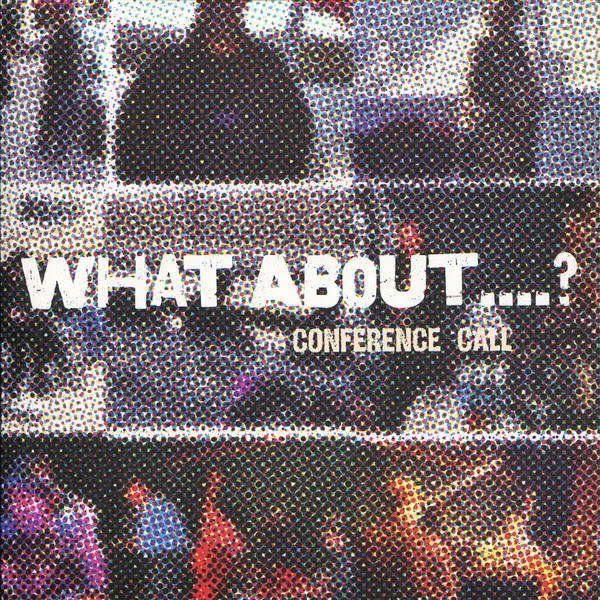
Conference Call - What About...?

CONFERENCE CALL:
Gebhard Ullmann: tenor & soprano saxophones, bass clarinet
Michael Jefry Stevens: piano
Joe Fonda: bass
George Schuller: drums, percussion

Conference no longer needs introduction. It's the stellar free jazz band consisting of Gebhard Ullmann on tenor saxophone, soprano saxophone, and bass clarinet, Michael Jefry Stevens on piano, Joe Fonda on bass, and George Schuller on drums. A kind of supergroup if you want.

The first piece, called "After Like, Part 1" is fully improvised and creates an otherwordly eery environment, without real established rhythm, or patterns whatsoever. It is organic and flows like the wind, grows like nature, with the power and drive increasing as it moves forward. It is fantastic. The next piece is in the same vein, certainly at the beginning closer to free improv than to jazz.

Then you have a style-shift for the next three pieces, which are composed, and built around traditional concepts, although they do evolve into exploratory timbral excursions, yet the harmonics, the theme remain the central focal point, whether ballad-like, as on "What About The Future?", or boppish as on "Circle".

CD2 starts with "After Like, Part 3", the qualitative equivalent of the first tracks of the first CD, fully in the same vein, and equally stellar: Ullmann's playing is fabulous, but the eery accents by Stephens, Fonda's arco and Schuller's extended use of percussive possibilities are of the same high level.

But then to my dismay, the next piece is a polka! True, it gets the necessary deconstruction, but to hear this somewhat humorous track after you've been entranced by a fabulous musical universe, is a real shame. "Litmus" is boppish again, and the last two pieces could again be part of the more serious atmosphere of the first track. Ullmann is better than I have heard him before.

So you get the bizarre mixture of real artistic creation with some silly or plain entertaining music, true, all brought with great skills and drive, but somehow not fitting together.

A selection of the best pieces on the album would have resulted in a real musical treat. Two great albums in two different styles somehow got mixed here. (from Free Jazz)

2010 CD1 / CD2

Frode Gjerstad & Lasse Marhaug - Red Edge

Frode Gjerstad: saxophone
Lasse Marhaug: electronics

2002 RED EDGE

Cecil Taylor Quartet - Nailed

Cecil Taylor: piano
Evan Parker: soprano & tenor saxophones
Barry Guy: bass
Tony Oxley: drums

Reviewby Thom Jurek

A super-session in theory, this one-off gig was recorded in Berlin in 1990 during another of Cecil Taylor's extended stays. According to the liner notes, this gig was tense from the start because of some ill will between some of the band's members, hence the title of the album. Whatever. The two tracks that comprise this set are full of the explosive, full-bore playing each of this quartet's members is well-known for. It's easy to believe there is tension here, the playing from the outset starts at furious and gets wilder. But what's more interesting is that given Taylor's gigantic stature among musicians, even the three he's playing with, he doesn't dominate the proceedings. This is group improvisation the way it's supposed to be, with ideas being tossed into the fire from every angle. Some are picked up and extrapolated upon; others are left smoldering in the ashes. When it is time for Taylor to solo, none of the others stay out of the mix completely, not even Parker. Guy's bowed bass accompanies Taylor through each theme and phrase, each color and mode change until Taylor cedes the floor. Yes, it is all about muscle: all competition, all struggle, all music. As in the bebop days of old, this is a cutting contest in the purest sense of that word. Everybody bleeds here. At times, the playing is so intense the listener just wants to hate everyone on the bandstand, at others, so forceful (s)he is beaten into submission, and still at others, nothing but a resounding YEAH! Throughout the house or car will do. Sizing up the individual contributions to this mass of aural mayhem is fruitless. This is a group who insists on being individuals in a collective setting and, therefore, the listening level is so high -- so as not to miss any gauntlet laid down -- the attention to execution and imagination can't help but be top-notch. So, in essence, this is a super-session, but not one in the usual sense. It is among the finest of all the recordings released under Taylor's name from either of his Berlin periods, and, for the others, it charts with their best playing anywhere. This is group improvisation at its angriest, freest, and truest.


1990 NAILED (fmp)

Daunik Lazro Quartet - Periferia

Daunik Lazro: alto & baritone saxophones
Carlos Zingaro: acoustic & electroacoustic violins
Sakis Papadimitriou: piano
Jean Bolcato: bass, voice

1993 PERIFERIA

The Thing - Action Jazz

Mats Gustafsson: baritone, alto & slide saxophones
Ingebrigt Håker-Flaten: bass
Paal Nilssen-Love: drums

2006 ACTION JAZZ
AllAboutJazz

Kenneth Terroade - Love Rejoice

Kenneth Terroade: tenor saxophone, flute
Ronnie Beer: alto & tenor saxophones
Evan Chandley: bass clarinet, flute
François Tusques: piano, balafon
Beb Guerin: bass
Earl Freeman: bass
Claude Delcloo: drums

1969 LOVE REJOICE

vendredi 9 juillet 2010

Fred Van Hove, Paul Dunmall, Paul Rogers, Paul Lytton - Asynchronous

Fred Van Hove: piano
Paul Dunmall: tenor saxophone
Paul Rogers: bass
Paul Lytton: drums

This is a quartet of 1970s-vintage European free-improvisers – three out of four called Paul – still warming to the task in 2008. Saxist and bass clarinettist Paul Dunmall's model was Evan Parker, while Paul Lytton actually played drums with Parker for years. Bass virtuoso Paul Rogers has spanned the postbop and improv scenes here and in New York, and Belgian pianist and movie composer Fred Van Hove started as a bebopper in the late 50s, then loosened up to spar with German sax free-blaster Peter Brötzmann. All that spontaneous music-making was caught at the Europa jazz festival in Le Mans in May 2008. There are only two tracks: one lasting 46 minutes and one of 15 minutes, with Dunmall's big, rounded sound and spiralling runs bursting out of a low-key overture, and then engaging in a long, dignified dance with Rogers's dark bowed chords. Dunmall sometimes builds solos in patterns of brief, squirted sounds a la Evan Parker, but he stays closer to post-Coltrane tonality for more of the time. Meanwhile, Van Hove unleashes glittering streams of notes with a Cecil Tayloresque intensity; his solo on the first track has an orchestral scope. The shorter episode begins as a bass drone pulsating like a didgeridoo, builds to the best full-on free-playing on the album, shifts to a lament-like section, a briefly resurfacing turmoil, and then evaporates into silence. An attentive and responsive quartet of experts in the genre. (from guardian)

2010 ASYNCHRONUS

OM (Urs Leimgruber, Christy Doran, Bobby Burri, Fredy Studer) - Om Willisau

Urs Leimgruber: soprano & tenor saxophones
Christy Doran: guitar, devices
Bobby Burri: bass, devices
Fredy Studer: drums, percussion

2010 OM : WILLISAU
Review

mardi 6 juillet 2010

New contributors

I'll be absent rather until September, my connection sucks too much and I don't have records anymore to share, thus let me know (at hjulien@hotmail.fr) if you wanna contribute to this blog... I don't want this blog dies! Thanks

jeudi 1 juillet 2010

Oluyemi Thomas & Gino Robair - Unity in Multiplicity

Oluyemi Thomas: flute, bass clarinet, c-melody & soprano saxophone, percussion, gong
Gino Robair: percussion, whirled instruments, motorized implements, toy horns, calabash

1995 UNITY IN MULTIPLICITY

Spontaneous Music Ensemble - Karyobin

Derek Bailey: electric guitar
Evan Parker: soprano saxophone
Kenny Wheeler: trumpet, flugelhorn
Dave Holland: bass
John Stevens: drums

Reviewby Scott Yanow

This CD reissues the second album by the Spontaneous Music Ensemble, retaining two musicians from the initial 1966 set (trumpeter Kenny Wheeler and drummer John Stevens) and adding Evan Parker on soprano, guitarist Derek Bailey and bassist Dave Holland. The young British all-stars (all virtually unknown at the time) stretch out on the six-part "Karyobin," playing quite freely in an idiom influenced a bit by their American contemporaries but already on its way to developing a more European sound. Bailey is mostly in the background with the key voices being Wheeler and Parker, but all five musicians make their contributions. The music is episodic and ends inconclusively but rewards repeated listenings. An important early recording for these five future greats.


1968 KARYOBIN

lundi 28 juin 2010

Joseph Jarman - Song For

Joseph Jarman: alto saxophone, voice
Fred Anderson: tenor saxophone
William Brimfield: trumpet
Christopher Gaddy: piano, marimba
Charles Clark: bass
Steve McCall: drums
Thurman Barker: drums

Reviewby Scott Yanow

This was one of the early classics of the AACM. Altoist Joseph Jarman, who would become a permanent member of the Art Ensemble of Chicago shortly after this recording, is heard in a sextet with trumpeter William Brimfield, the legendary tenor Fred Anderson, pianist Christopher Gaddy, bassist Charles Clark, and either Steve McCall or Thurman Barker on drums. The four very diverse improvisations include one that showcases a Jarman recitation, a dirge, the intense "Little Fox Run," and the title cut, which contrasts sounds and a creative use of silence. Overall, this music was the next step in jazz after the high-energy passions of the earlier wave of the avant-garde started to run out of fresh ideas. It's recommended for open-eared listeners. The 1996 CD reissue adds an alternate take of "Little Fox Run" to the original program.


1967 SONG FOR
thanks a lot to Joao from exp etc

samedi 26 juin 2010

Daniel Humair, Tony Malaby, Bruno Chevillon - Pas de dense

Daniel Humair: drums
Tony Malaby: saxophone
Bruno Chevillon: bass

Two years ago, Swiss drummer Daniel Humair released "Full Contact" with Tony Malaby on sax and Joachim Kühn on piano for a whirling series of intense improvisations. Now, two years later, the piano is replaced by French bassist Bruno Chevillon.

The playing is no less intense, and spread over 12 "séquences", that move quite organically one into the other. Although fully improvised, the pieces are quite boppish and Malaby's natural lyricism make this a quite accessible album. Humair's drumming is like on the previous album : powerful and subtle at the same time, a fine quality which also defines the overall nature of the music. Malaby is never less than sensitive, whether in the weak squeals of "Séquence HCM 4", or in his full-voiced Latin phrasing of "Séquence HCM 3". Fans of Malaby will recognize some of his signature phrasings on several pieces, yet that does not really bother, quite to the contrary, since there is again such a wealth of ideas that there is no risk of repetition from previous albums.

Whether swinging or abstract avant-gardism, the three musicians feel equally at ease in every environment, and have sufficient stories to tell, playing with tone, timbre, silence, phrasing, rhythm, interaction, density, volume, pulse in a way that can only be admired from beginning to end. The relative shortness of the pieces forces the musicians to create with a rare immediacy: you have to listen and be in the improvisation on the moment to make it work : there is no time to listen and absorb the other's ideas. And that's possibly the unusual power of this album: even if the improvisation is only two minutes long, or even one minute, the trio moves the initial notes or rhythm into a tiny story, with its own characteristics, development and ending, an improvised capsule of intimate conversation. So there is no real soloing, the trio creates the sound together, as one dense mass, yet full of shifting flavors. The last piece, because of its length, shows a different, more expansive side of the trio's possibilities, with room for soloing, and it is a great ending for the album.

Even if the music is less expressive than on "Tamarindo" or "Voladores", possibly because of the compactness of the pieces which does not allow for long developments, the end result is an absolute joy.
(http://freejazz-stef.blogspot.com/2010/05/daniel-humair-tony-malaby-bruno.html)

2010 PAS DE DENSE

lundi 21 juin 2010

Keith Rowe, Martin Küchen, Seymour Wright


Keith Rowe: electric guitar
Martin Küchen: alto saxophone
Seymour Wright: alto saxophone

The dual alto saxophones of Martin Kuchen and Seymour Wright meet guitarist Keith Rowe for an impressive journey of free improvisation with Rowe generally taking the lead. The pieces are sparse, building in ebb and flow, with both saxophonists using extended techniques and the action of the instrument intself to create a quilt of timbre, buzz and sound. The single long improvisation is beautifully paced to create an aura of mystery, building implicit chapters in extended passages of flowing abstraction.

2010 ROWE/KÜCHEN/WRIGHT

vendredi 11 juin 2010

Derek Bailey & Han Bennink - ICP 004

Derek Bailey: guitar
Han Bennink: drums, oeoe, gachi, conch-trumpet

1969 ICP 004

Kihnoua - Unauthorized Caprices

Larry Ochs: sopranino & tenor saxophones
Dohee Lee: voice
Scott Amendola: drums, electronics
Liz Allbee: trumpet, electronics (tracks 1,2,5)
Fred Frith: guitar (track 2)
Joan Jeanrenaud: cello (tracks 2,5)

Kihnoua is a new ensemble that combines the thoughts, sounds, and structures of contemporary improvised music with the traditional music of Asia and other folk-music influences from Asia, Africa, and Europe. With Larry Ochs of the critically acclaimed Rova Saxophone Quartet, drumming powerhouse Scott Amendola, composer, vocalist, and dancer Dohee Lee, and acclaimed cellist Joan Jeanrenaud, plus guests: Liz Albee on trumpet & electronics, Fred Frith on guitar and Joan Jeanrenaud on cello. I didn't know this vocalist, Ms. Dohee Lee, before this disc, but this is a good showcase for her as an integral part of Larry Ochs' fine new trio. Both Scott Amendola and Liz Allbee contribute strange electronics sounds to the long opening piece which works well with Ms. Lee's bizarre vocal sounds. You can tell that Mr. Ochs' exhilarating sax and Mr. Amendola's propulsive drumming have been working together for many years since they compliment each other so well. Ms. Allbee is another strong Bay Area improviser who has worked with Henry Kaiser, Damon Smith and Weasel Walter previously. Ms. Allbee contributes a good deal of extended trumpet sounds to these pieces and is also a good match for Larry, Scott and Dohee. Former Kronos cellist Joan Jeanrenaud & guitarist Fred Frith add their sonic spice to a long piece called "Nothing Stopped but a Future" which is expertly navigated by Scott's strong drumming. Joan's soaring cello adds flames to this burning piece while Dohee's voice and Larry's sax swirl intensely around one another. Ms. Lee's scary whispered vocals are featured on "DeeHyak" while she erupts on "Weightless", spewing out intense layers aggressive vocals with sprawling drums underneath. This disc is one of the most intense and spirited exhibitions I've heard in recent memory. Don't miss out on this jewel. - Bruce Lee Gallanter, Downtown Music Gallery

2010 UNAUTHORIZED CAPRICES

mercredi 2 juin 2010

Sun Ra and his Solar-Myth Arkestra - The Solar-Myth Approach

Sun Ra (piano, moog, clarinette), Kwame Hadi (trompette), Ahk Tal Ebah (trompette, mellophone), Ali Hassan (trombone), Charles Stevens (trombone), Marshall Allen (saxophone alto, haut-bois, flûte, piccolo), Danny Davis (saxophone alto, clarinette, flûte), John Gilmore (saxophone ténor, percussions), Danny Thompson (saxophone bariton, flûte), Pat Patrick (saxophone bariton, flûte), James Jacson (haut-bois, flûte, percussions egyptiennes), Ronnie Boykins (basse), Clifford Jarvis (percussions), Lex Humphries (percussions), Nimrod Hunt (percussions), June Tyson (chant), Art Jenkins (chant)

Reviewby Lindsay Planer

These two discs from Sun Ra and his Solar Myth Arkestra are not, as their title suggests, parts of a singular or continuous work. They were initially issued as two separate titles -- similar to the two-part Heliocentric Worlds of Sun Ra -- by the Belgian BYG Actuel label in 1971. Both volumes consist of mid-fidelity and primarily self-realized and -produced recordings. Despite the claim that these sides were taped in New York City at Sun Studios, Ra discographer Robert L. Campbell notes that by the time these tracks were documented, the Arkestra had ended its N.Y.C. residency and returned to Philadelphia. Although this collection may not be the highest priority for potential converts or the uninitiated, there is a tremendous spectrum of sounds from Ra and the Arkestra on these discs. Volume One ranges from the atonal sparseness of the keyboard solo "Seen III Took 4" to the equally intimate ensemble work of "Adventures of Bugs Hunter" -- which in true Ra fashion doesn't even feature the musician. There are also more percussive works such as "Realm of Lightning" -- whose lead instrument sounds like newspaper being struck with pencils. This is augmented with a percussive onslaught featuring several distinct waves of rapid and emphatic timbale-style solos. The performances on Volume Two contain a noticeably heavier and more aggressive sound from the Arkestra. "The Utter Nots" is a classic example of many early-'70s arrangements, which were becoming almost ridiculously arithmetical. The extended work features some inspired and nimble fretwork from Ronnie Boykins (acoustic bass). Also of note are early renderings of "Outer Spaceways, Inc." and "The Satellites Are Spinning." These vocal tracks would be reworked and recycled into Ra's groundbreaking film Space Is the Place. [In 2001, after some years in obscurity, The Solar Myth Approach, Vol 1-2 was issued as a two-CD set for the first time in the domestic U.S.]


1970 THE SOLAR-MYTH APPROACH VOL. 1 & VOL. 2

mardi 1 juin 2010

Larry Ochs, Jean Jeanrenaud, Miya Masaoka - Fly Fly Fly

Larry Ochs: tenor & sopranino saxophones
Joan Jeanrenaud: cello
Miya Masaoka: koto

2004 FLY FLY FLY
Review

Archie Shepp - Live at the Pan-African Festival

Archie Shepp: tenor saxophone
Clifford Thornton: cornet
Grachan Moncur III: trombone
Dave Burrell: piano
Alan Silva: bass
Sunny Murray: drums
plus algerian & tuareg musicians

Reviewby Bob Rusch, Cadence

Archie Shepp probably led more BYG recordings than anyone else. The first of his BYG's has been reissued as Live At The Pan African Festival. The Pan African Festival in Algiers served as a great realization of art and culture for many of the participants and on this recording we heard Shepp, Clifford Thornton, and Grachan Moncur III in an impromptu jam ("Brotherhood at Ketcha") with various native Algerian percussionists and "horn" men...Any study of Shepp makes listening to all of his BYG recordings essential.


1969 LIVE AT THE PAN-AFRICAN FESTIVAL

Art Ensemble of Chicago - A Jackson In Your House / Message To Our Folks

Lester Bowie: trumpet, flugelhorn, bass drum, horns
Roscoe Mitchell: soprano-,alto- & bass-saxophones, clarinet, flute, cymbals, gongs, conga drums, logs, bells, siren, whistles, steel drum, etc.
Joseph Jarman: soprano & alto saxophones, clarinet, oboe, flute, marimba, vibes, conga drums, bells, whistles, gong, siren, guitar, etc.
Malachi Favors: bass, fender bass, banjo, log drum cythar, percussion, etc.

1969 A JACKSON IN YOUR HOUSE / MESSAGE TOUR FOLKS
Review

Archie Shepp - Blasé

Archie Shepp: tenor saxophone
Jeanne Lee: vocal
Lester Bowie: trumpet, flugelhorn
Chicago Beau: harmonica
Julio Finn: harmonica
Dave Burrell: piano
Malachi Favors: bass
Philly Joe Jones: drums

1969 BLASE

Don Cherry - Mu

Don Cherry: pocket trumpet, indian & bamboo flutes, piano, vocals, bells, percussion
Ed Blackwell: drums, percussion, bells

1969 MU