Affichage des articles dont le libellé est Gebhard Ullmann. Afficher tous les articles

jeudi 6 janvier 2011

The Ullmann Swell 4 - News? No News!


THE ULLMANN SWELL 4 - News? No News! (Jazzwerkstatt, 2010)

Gebhard Ullmann: tenor saxophone, bass clarinet
Steve Swell: trombone
Hilliard Greene: bass
Barry Altschul: drums

01. More Hello [05:18]
02. New York 5:50 [07:04]
03. Composite #1 [09:46]
04. Kleine Figuren #2 [05:23]
05. Planet Hopping On A Thursday Afternoon [07:03]
06. GPS #1 [05:27]
07. News? No News! [07:58]
08. GPS #2 [03:27]
09. Berlin 9:35 [07:39]
10. Airtight [10:01]

In these days of global jazz alliances, the partnership of downtown trombonist Steve Swell and German reedman Gebhard Ullmann won't raise too many eyebrows. More noteworthy is its endurance, spanning some six years since its auspicious inception with Desert Songs and Other Landscapes (CIMP, 2004). Swell is also a fixture in Ullmann's Basement Research band, another combo that shows similar staying power. News? No News!, a studio date on Berlin's Jazzwerkstatt imprint, constitutes a worthy successor to the CIMP, featuring an unchanged lineup completed by Hilliard Greene on bass and the illustrious Barry Altschul behind the drums. Democratic intent is signaled by division of writing duties with four pieces penned by each of the co-leaders along with two group improvisations rounding out a generous 69-minute program.

Both Swell and Ullmann are exciting soloists: the saxophonist's throaty tenor can barely contain his energy in the shrieks and cries adorning Swell's rumbustious shout-out, "More Hello," while his yelping bass clarinet at times recalls Eric Dolphy in its vocalized chuckle (adroitly echoed by Altschul), as on the fluent "GPS#2." A willing foil throughout, the trombonist's tender bluster and vivacious expressiveness both complement and challenge his partner.

One of the pleasures of this set is the interaction between the two horns, with an a cappella duet seeding the open debate of "Composite #1," while their clarion chorus places the cherry on top of the reedman's "Berlin." Greene's powers of propulsion and timbral variation are ably abetted by Altschul's crisp on-the-money drums in a pairing which is as tight as it is flexible. They plot the genial lope of Swell's "Planet Hopping On A Thursday Afternoon" and the urgent knotty rush of the closing "Airtight" with equal aplomb.

Such refined but not rote interplay remains one of the defining characteristics of this band and, when allied to their unpredictable charts, makes for a winning combination. Ullmann's "New York" evokes the opening of Charles Mingus' The Black Saint and the Sinner Lady (Impulse!, 1963) in its braying theme over two-speed bass throb and driving drums, while the confident swagger of his "Berlin" transmutes by way of involved exploration into a more wistful conclusion, reflecting the range and ingenuity of the arrangements.

Even the improvisations have satisfying structure, as with "GPS #1" where a measured group discourse of breathy harmonics and whispered asides is sandwiched between Greene's wavering arco whale song and a tolling bass and drum duet finale, confirming an early contender for those year-end best-of lists. (from AAJ)

HERE

mercredi 5 janvier 2011

Gebhard Ullmann, Chris Dahlgren, Jay Rosen - Cutitout

Gebhard Ullmann, Chris Dahlgren, Jay Rosen - Cutitout (Leo Records, 2006)

Gebhard Ullmann: bass clarinet, bass flute
Chris Dahlgren: bass, electronics
Jay Rosen: drums, percussion

01. Grid Speak
02. Calling Mr. Waits
03. U.S.O. Ballad
04. Lolligager
05. No Mouthpiece
06. Calling Mr. Waits (part 2)
07. Mbira
08. Walking Under Trains
09. Bass-bass
10. Epilog (ballad no.2)

German multi-woodwind player Gebhard Ullmann found the cover art for Cut It Out in the hallway of his Berlin apartment building, and he and bandmates "found the music"—these spontaneous compositions—in bassist Chris Dahlgren's Brooklyn living room, where they recorded the disc, creating a set of sounds that have an spontaneous feeling all the way through.

Ullmann presents his music in various ensemble setups, from big band to mid-sized groups to trios. Two of the prolific musician's best works come from his trio outings. BassX3 (Drimala Records, 2005) featured Ullman on bass clarinet and bass flute, backed by two string basses; and now Cut It Out finds him with bassist Chris Dahlgren and drummer Jay Rosen. Again, Ullman plays bass clarinet and bass flute, showing off his affinity for the lower register on a mostly minimalist set that often seems to creep and crawl on a subliminal level, like burgeoning life churning implacably in the humus on the jungle floor.

The minimalist/subliminal/low-register character can cause a listener who's not wired into the free nature of the sound to miss out of the inticacies of the three-way converstations. Drummer Jay Rosen, who plays on numerous CIMP Spirit Room discs, is a marvel at subtle textures juxtaposed with interludes frenetic cymbal explosions, while Ullmann and Dahlgren lurk around in the shadows, issuing deep-toned proclamations.

Cut It Out is not for listeners who are uninitiated to the sounds of the freer side of jazz, but for those who've been there, it has a definite allure. (from AAJ)

HERE

dimanche 11 juillet 2010

Conference Call - Final Answer

CONFERENCE CALL:
Gebhard Ullmann: soprano saxophone, bass clarinet
Michael Jefry Stevens: piano
Joe Fonda: bass
Matt Wilson: drums

Reviewby Thom Jurek

Conference Call is a quartet made up of reed and woodwind master Gebhard Ullmann, bassist Joe Fonda, the criminally under-recorded pianist Michael Jefry Stevens, and drummer Matt Wilson. This date is not a session by a group of musicians who've adopted a moniker, but a full-on working band who rehearses, composes, and plays together as often as it can since each member is a working soloist in his own right. The prime directive here is, not unexpectedly, Ullmann's intense and fluid sense of off-kilter lyricism. His seamless approach to the horn and staggered sense of open harmonics and tonal structuralism are ever-present. What is surprising is his pairing with Stevens on the front line. Stevens is a knotty pianist whose influences are Cecil Taylor, Bill Evans, Andrew Hill, McCoy Tyner and Horace Silver. His stunning architectural renderings of vast, previously unshaped chords; minor shadings; and furious ostinato are tremendous solo gifts, but in this ensemble, they create a wide and deep floor for not only Ullmann as a soloist, but for the rhythm section as well. What's more, Stevens provides the necessary punch and clamor for the band to swing unencumbered by their considerably complex improvisational style, which is often slipped inside a scored section or bridge. A fine example is "Could This Be a Polka," an effortless series of off-minor piano phrases strung together by the bassline and loped into a melody by Ullmann's gorgeous restraint and willingness to turn the harmony inside out in an even exchange with the impressionistically beautiful melody. Elsewhere, the band's theme, written by Ullmann, features all of the band's intensity and tension in a furiously paced, yet wonderfully rendered melodic architecture of tonal inquiry and multi-scalar invention. But it is Stevens' shimmering balladry on "Liquid Cage" that brings all of the band's influences into play. There is the sense of silence and tension as compositional elements à la Morton Feldman, the notion of tonality itself as a construct of not only sonic dimension, but metaphysical space as well. The idea that rhythm can exist in a melody this intricate and subtle is revolutionary, but Fonda and Wilson carve out a space in inner space and inform and extend the improvisational structures that emanate from the heart of Stevens' gloriously restrained pianism. This is a remarkable record with a surprise at the end that will leave the listener wondering why this band isn't headlining festivals all over the world.


2002 FINAL ANSWER

samedi 10 juillet 2010

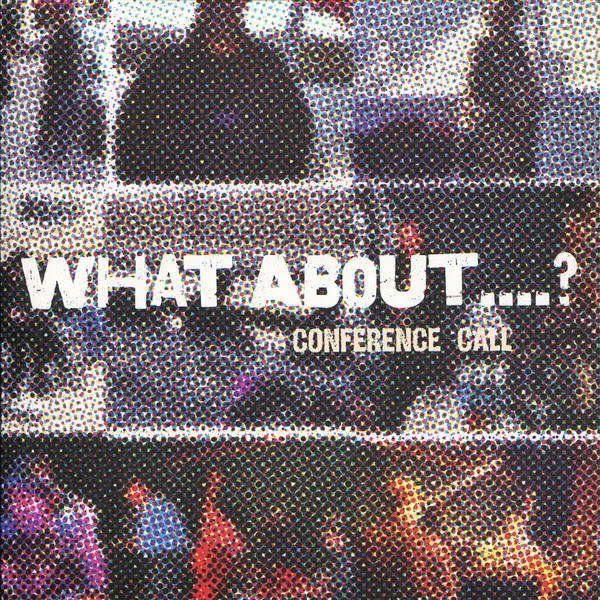
Conference Call - What About...?

CONFERENCE CALL:
Gebhard Ullmann: tenor & soprano saxophones, bass clarinet
Michael Jefry Stevens: piano
Joe Fonda: bass
George Schuller: drums, percussion

Conference no longer needs introduction. It's the stellar free jazz band consisting of Gebhard Ullmann on tenor saxophone, soprano saxophone, and bass clarinet, Michael Jefry Stevens on piano, Joe Fonda on bass, and George Schuller on drums. A kind of supergroup if you want.

The first piece, called "After Like, Part 1" is fully improvised and creates an otherwordly eery environment, without real established rhythm, or patterns whatsoever. It is organic and flows like the wind, grows like nature, with the power and drive increasing as it moves forward. It is fantastic. The next piece is in the same vein, certainly at the beginning closer to free improv than to jazz.

Then you have a style-shift for the next three pieces, which are composed, and built around traditional concepts, although they do evolve into exploratory timbral excursions, yet the harmonics, the theme remain the central focal point, whether ballad-like, as on "What About The Future?", or boppish as on "Circle".

CD2 starts with "After Like, Part 3", the qualitative equivalent of the first tracks of the first CD, fully in the same vein, and equally stellar: Ullmann's playing is fabulous, but the eery accents by Stephens, Fonda's arco and Schuller's extended use of percussive possibilities are of the same high level.

But then to my dismay, the next piece is a polka! True, it gets the necessary deconstruction, but to hear this somewhat humorous track after you've been entranced by a fabulous musical universe, is a real shame. "Litmus" is boppish again, and the last two pieces could again be part of the more serious atmosphere of the first track. Ullmann is better than I have heard him before.

So you get the bizarre mixture of real artistic creation with some silly or plain entertaining music, true, all brought with great skills and drive, but somehow not fitting together.

A selection of the best pieces on the album would have resulted in a real musical treat. Two great albums in two different styles somehow got mixed here. (from Free Jazz)

2010 CD1 / CD2